
A precision-engineered guide for commercial and industrial climate control in the UK. Calculate the exact cooling capacity required for your Hampshire facility, accounting for modern building regulations and thermal heat loads.
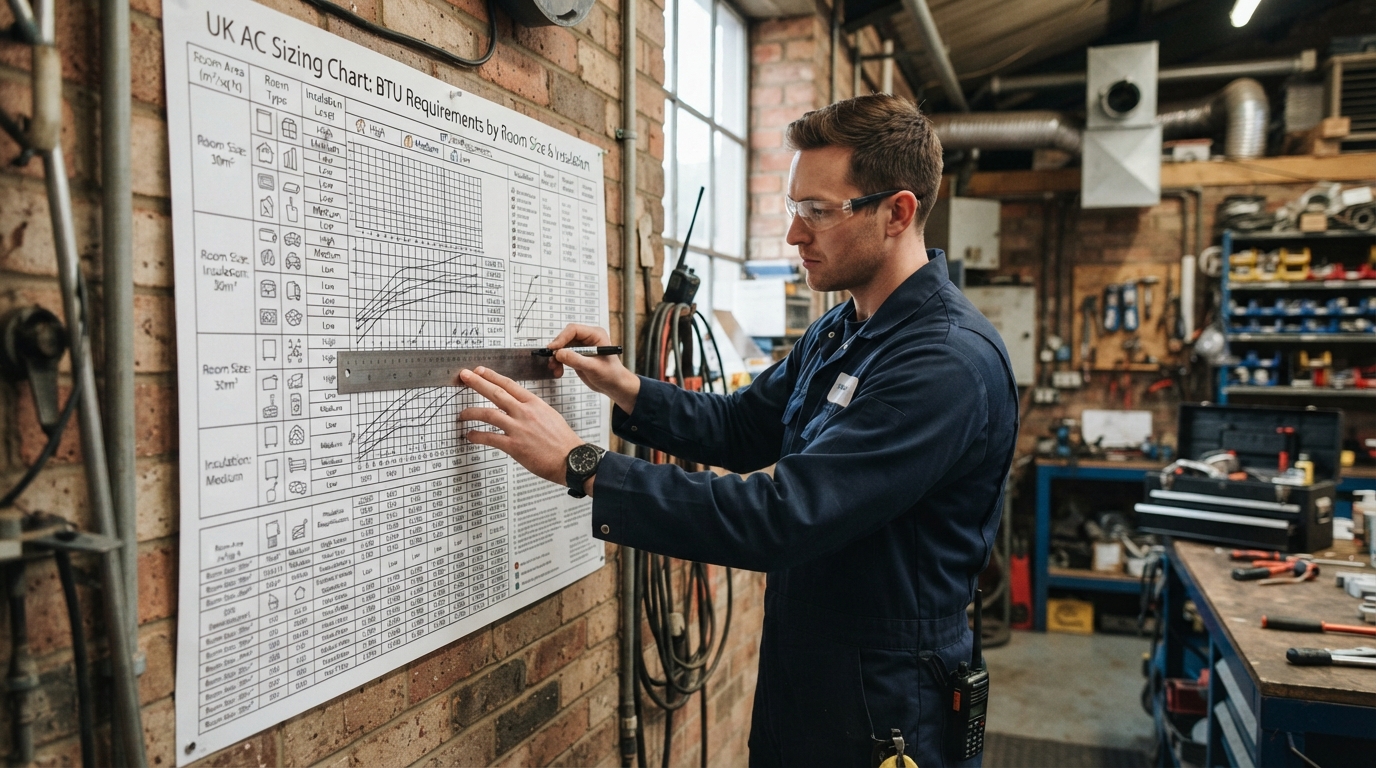
Professional Precision in Climate Control
Selecting the correct air conditioning unit is not merely about square footage. In the UK commercial and industrial sectors, variables such as ceiling height, machinery heat output, and glazing orientation significantly impact your cooling requirements. With over 25 years of experience serving Southampton, Portsmouth, and the wider Hampshire area, HVAC understands that a generic “one size fits all” approach often leads to inefficiency and premature system failure.
This technical reference chart provides the data needed to begin your commercial HVAC system design. Whether you are outfitting a high-density server room or a sprawling warehouse, accurate BTU (British Thermal Unit) and kW (Kilowatt) calculations are the foundation of energy efficiency.
Primary AC Sizing Reference Chart
The following table provides base cooling requirements for standard UK commercial spaces with a ceiling height of 2.4m (8ft). For industrial units with higher ceilings, please refer to the volumetric calculations below.
| Floor Area (sq m) | Floor Area (sq ft) | Cooling Capacity (BTU) | Cooling Capacity (kW) | Typical Application |
|---|---|---|---|---|
| 10 – 15 | 107 – 161 | 5,000 – 7,000 | 1.5 – 2.1 | Small Office / Storage Room |
| 16 – 25 | 172 – 269 | 9,000 | 2.6 | Standard Office / Meeting Room |
| 26 – 35 | 280 – 376 | 12,000 | 3.5 | General Workspace / Retail Unit |
| 36 – 50 | 387 – 538 | 18,000 | 5.2 | Large Open Plan Office |
| 51 – 70 | 548 – 753 | 24,000 | 7.0 | Restaurant / Commercial Showroom |
| 71 – 90 | 764 – 968 | 30,000 | 8.8 | Industrial Workshop / Laboratory |
| 91 – 120 | 979 – 1,291 | 36,000 | 10.5 | Large Commercial Floor / Warehouse Space |
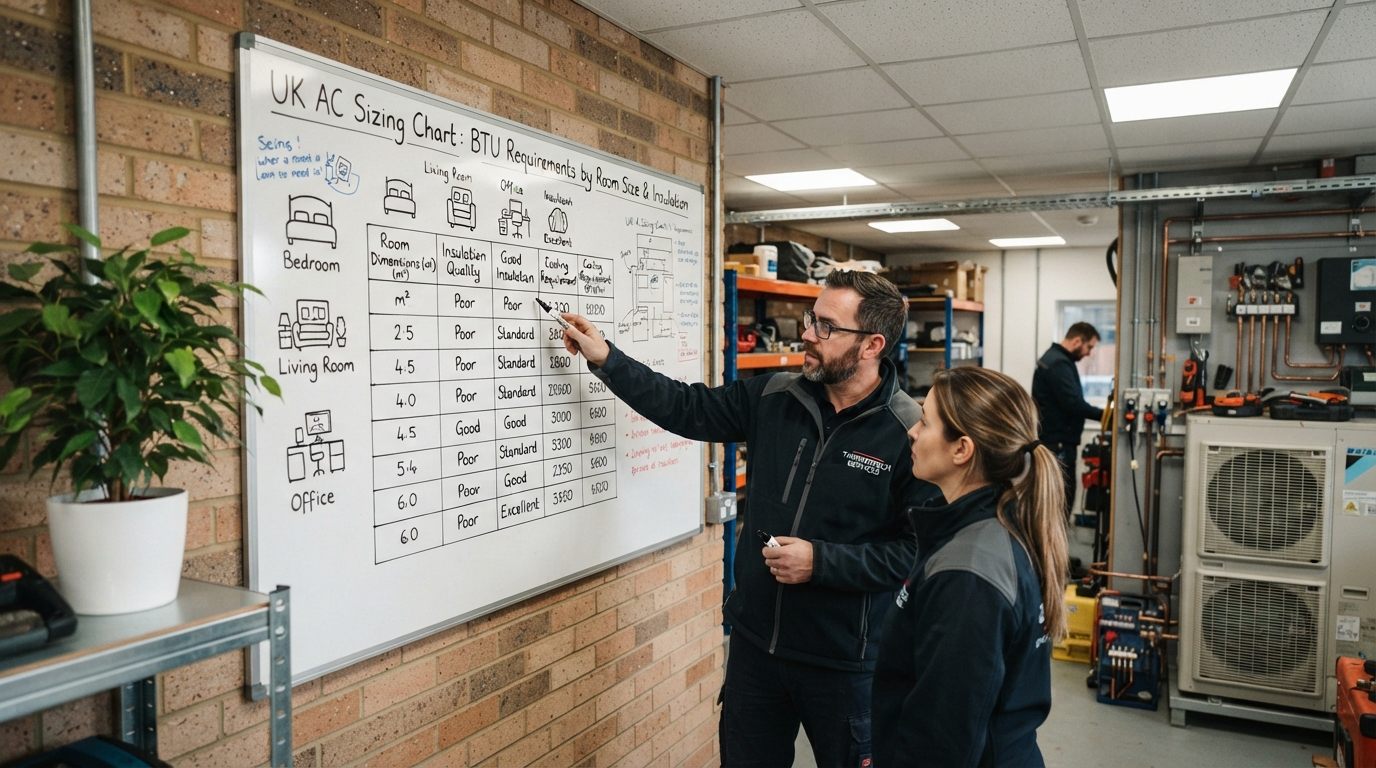
Advanced Variables: Insulation & Heat Load Factors
In the UK, the “Rule of Thumb” often fails because it ignores building fabric. Modern “Grade A” new builds in the Southampton region retain temperature differently than converted heritage warehouses in Portsmouth. To achieve a “Bespoke” cooling solution, apply these adjustment factors to the base BTU values above.
Insulation Quality
- Modern (Post-2010 Building Regs): Subtract 10% from total BTU requirements.
- Standard (Double Glazed/Cavity Wall): Use chart values as shown.
- Poor (Single Glazed/Old Commercial): Add 15-20% to the total BTU capacity to compensate for heat gain.
Solar Heat Gain
Large windows are common in modern South Coast offices. For rooms with significant South-Facing Glass, increase your BTU requirement by 10%. Conversely, if the room is heavily shaded or North-facing, you may decrease the requirement by 10%.
Occupancy & Equipment
Human bodies and electronic equipment generate significant “sensible heat.”
- People: Add 600 BTUs for every person beyond the second occupant.
- IT Equipment: Add 500 BTUs per workstation or server rack (consult our specialist for high-density data centres).
The UK Volumetric Formula
For industrial units and high-ceiling environments, area-based sizing is insufficient. Use the following volumetric standard for a more accurate baseline:
Length (m) x Width (m) x Height (m) x 141 = Required BTUs
Note: Multiplying the cubic volume by 141 is a standard UK baseline for moderate activity commercial spaces.
Why Sizing Matters for Energy Efficiency
At HVAC, we help our customers minimise energy use by providing advice on selecting the most efficient products. Sizing is the first step in this process.
The Risk of “Short-Cycling” (Over-sizing)
A common mistake in commercial procurement is buying a larger unit “just in case.” An oversized AC unit will reach the target temperature too quickly, leading to a phenomenon called “short-cycling.” This causes:
- Excessive wear on the compressor, shortening system lifespan.
- Poor dehumidification, leading to a “clammy” environment (critical in coastal areas like Southampton).
- Spikes in energy consumption as the motor repeatedly restarts.
The Risk of Constant Operation (Under-sizing)
Under-sizing a unit means it will run at 100% capacity indefinitely without ever reaching the setpoint. This is common in Hampshire server rooms where the equipment heat load was underestimated. This leads to system overheating, high electricity bills, and failure to maintain the necessary climate for sensitive electronics.

Expertise in Diverse Commercial Environments
Since 1999, we have applied these sizing principles across a variety of complex projects. Our work at Southampton General Hospital and Exton Vineyard demonstrates the necessity of bespoke sizing—hospitals require high air-turnover rates, while vineyards require precise humidity and temperature control for product integrity.
If you are exploring modern heating solutions alongside cooling, consider our research on hybrid heat pump and solar PV integration for a truly carbon-efficient facility.
Frequently Asked Questions
BTU (British Thermal Unit) is a traditional imperial measurement of heat, while kW (Kilowatt) is the metric standard for cooling power. In the UK, modern units are often marketed in kW. You can convert them by dividing the BTU figure by 3,412 (e.g., 12,000 BTU / 3,412 ≈ 3.5 kW).
Significantly. An office is sized based on people and volume, whereas a server room is sized based on the total wattage of the hardware. Every watt of power consumed by a server is converted into heat. A standard 12,000 BTU unit may cool a large office but might only support a single high-density server rack.
Yes. Higher humidity levels on the coast mean the air conditioner must work harder to remove moisture (latent heat). This often requires a system with a higher “latent cooling” capacity, even if the total BTU requirement remains the same.
A “Ton” of air conditioning refers to the cooling power required to melt one short ton of ice in 24 hours. It is equivalent to 12,000 BTUs per hour. If you see a “3-ton unit,” it is a 36,000 BTU system.
Get a Professional Heat Load Calculation
Charts provide a guide, but a professional survey ensures long-term reliability and energy efficiency. HVAC provides bespoke installations for small businesses and large industrial organisations across Hampshire.
With 25 years of experience, we provide professional design and maintenance services to the highest standards.
Contact Our Hampshire SpecialistsServing Southampton, Portsmouth, Salisbury, and the surrounding areas.