
R290 vs R32: Which Natural Refrigerant Maximises Energy Savings?
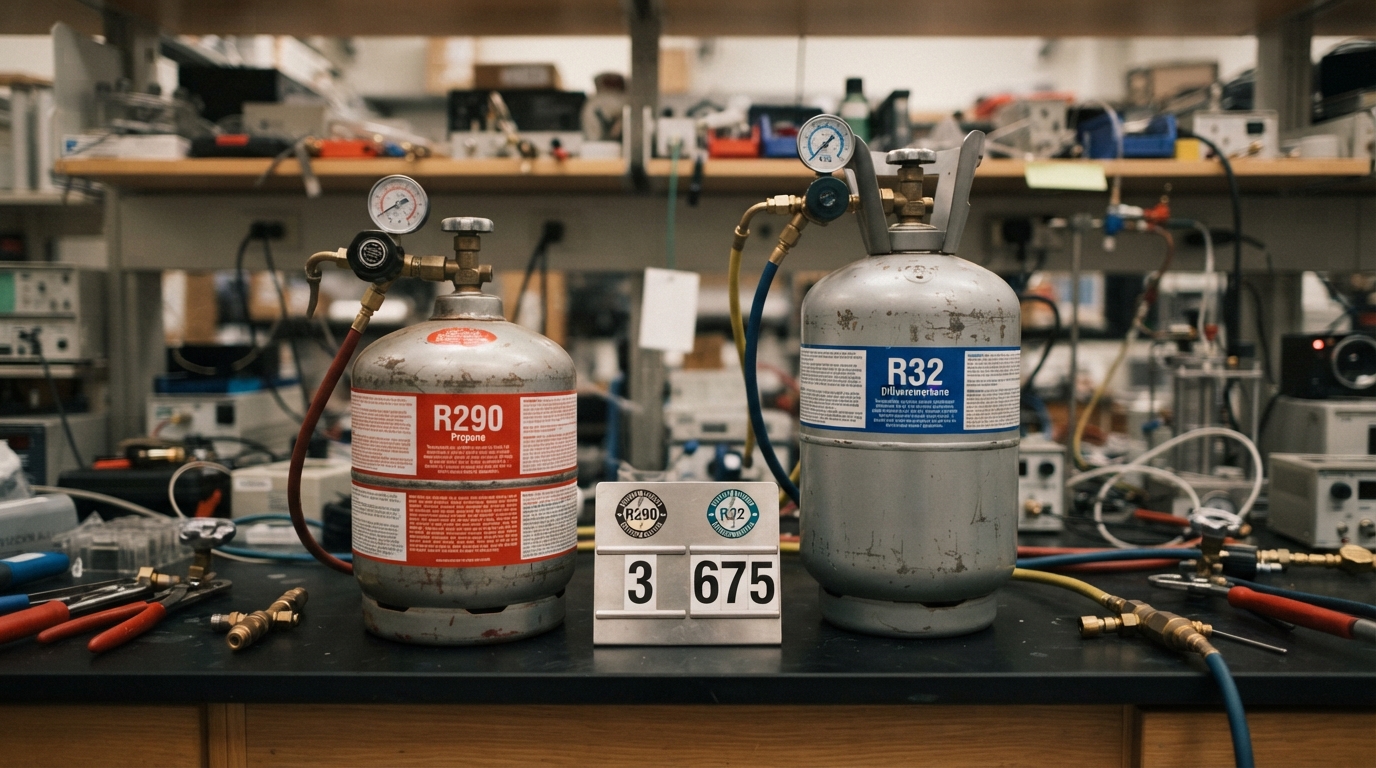
Did you know that R32, still one of the most widely fitted refrigerants in commercial air conditioning and heat pump systems, carries a Global Warming Potential of 675 compared to R290’s GWP of just 3? That single figure sums up why so many of our commercial and industrial customers across Hampshire are now asking us the same question: R290 vs R32, which natural refrigerant maximises energy savings, and which one should go into their next installation.

Key Takeaways
| Question | Quick Answer |
|---|---|
| Which refrigerant is more energy efficient? | R290 (propane) typically outperforms R32 by 10-20% in comparative efficiency testing. |
| Which has the lower environmental impact? | R290 has a GWP of 3 against R32’s 675, making it the clear winner on environmental grounds. |
| Is R290 safe for commercial use? | Yes, when installed correctly by qualified engineers, though flammability limits charge sizes. |
| Does R32 still have a place in new installations? | Yes, particularly in larger heat pump systems where charge size limits make R290 less practical. |
| Which refrigerant lowers running costs faster? | R290 systems can cut energy costs by around 25% compared with traditional alternatives. |
| Is R290 available for commercial refrigeration? | Yes, we now specify it regularly across our commercial refrigeration installations. |
| Which should you choose for a new project? | It depends on application, charge size and site safety, something our design department assesses project by project. |
R290 vs R32: What These Two Natural Refrigerants Actually Are
R32 is a hydrofluorocarbon (HFC) that replaced older, higher-GWP gases like R410A across much of the split air conditioning and heat pump market.
R290, on the other hand, is simply propane, refined to a minimum purity of 99.5% for refrigeration use. It’s classed as a natural refrigerant, sitting alongside CO2 and ammonia as an option that occurs in the environment rather than being manufactured purely for HVAC use.
When customers ask us R290 vs R32, which natural refrigerant maximises energy savings, we always start by explaining that only R290 is technically “natural” in the strictest sense, R32 is a synthetic gas with a much lower GWP than its predecessors but nowhere near as low as propane.
R290 vs R32: Which Natural Refrigerant Maximises Energy Savings on Paper?
On thermodynamic performance alone, R290 tends to win. Its molecular properties allow compressors to achieve strong heat transfer with less electrical input, which is exactly what drives real energy savings on site.
| Property | R290 | R32 |
|---|---|---|
| GWP | 3 | 675 |
| Ozone Depletion Potential | 0 | 0 |
| Flammability class | A3 (highly flammable) | A2L (mildly flammable) |
| Typical charge limit | Often restricted to around 150 grams | Higher charge limits permitted |
| Efficiency vs older refrigerants | 10-20% better | Moderate improvement |
As a rule of thumb, the smaller the system, the more sense R290 makes; the flammability limits that keep charge sizes low simply aren’t an issue in a small commercial fridge or bottle cooler.
Energy Savings in Real-World Commercial Refrigeration
We have designed and installed a controlled temperature insulated room for the storage of bottled wine, grown on vineyards at MJI Exton, and refrigerant choice was central to keeping that space efficient year-round.
Projects like this show why R290 vs R32, which natural refrigerant maximizes energy savings, isn’t just a theoretical debate. It has a direct line to the electricity bill.
Did You Know?
Hydrocarbons like R290 can reduce overall energy costs by around 25% for manufacturers and end-users.
Source: Red Tek
For cold rooms, bottle coolers and refrigerated display cabinets, that 25% figure isn’t hypothetical, it’s the sort of saving our refrigeration customers actually see once systems bed in.
Safety Considerations: Flammability, Charge Limits and Installation
R290 has a lower flammability limit (LFL) of 2.1% by volume, which is why charge sizes are restricted, often to around 150 grams in many applications.
R32 is classed A2L, mildly flammable rather than highly flammable, which allows larger charge sizes in bigger commercial systems without the same restrictions.
This is where an experienced design department earns its keep. Whatever your needs, whether that’s a small bottle cooler or a multi-pack refrigeration system serving a whole kitchen, the safety case has to be worked through properly before refrigerant choice is finalised.
We never cut corners here; getting the charge size, ventilation and leak detection right is non-negotiable, project large or small.
R290 vs R32 in Commercial Refrigeration Systems
Commercial refrigeration needs careful management, business owners cannot just put a fridge, freezer or chill cabinet in place and forget about it.
We supply and maintain beer cellars, cold rooms, ice makers and bespoke cooling systems across Hampshire, and R290 has become our default recommendation for smaller, self-contained units where charge limits aren’t a barrier.
For larger multi-pack systems serving supermarkets or wholesale sites, R32 (or in some cases CO2) often remains the more practical choice, simply because of the volume of refrigerant a bigger system requires.

R290 and R32 in Heat Pumps: Which Delivers Better Heating Performance?
Of course modern heat pumps do heating as well as cooling, and refrigerant choice affects that side of performance just as much.
As a rule of thumb, for every KW of electricity fed in during heating mode, a heat pump will output 2-3 KW because of its dual capability as a heat pump, and the refrigerant inside plays a direct role in hitting that ratio.
Did You Know?
In comparative tests, R290 systems demonstrated 10-20% better energy efficiency than systems using traditional refrigerants like R-134a or R-22.
Source: Refrigerant Sensor
As Specialist Service Technicians for Calorex Heat Pumps, we see this play out daily on service calls. Where propane-charged units are fitted correctly, the output-to-input ratio genuinely improves, which is exactly the sort of detail worth asking about when comparing heat pump quotes.
Air Conditioning Applications: DC Inverter Technology and Natural Refrigerants
With summers becoming warmer and employees becoming less tolerant of uncomfortable working conditions, now may be the time to increase your office workforce productivity by investing in comfort cooling.
With DC inverter compressors now available on most models, combining cutting edge technology with exceptional performance, speedy and powerful cooling and heating is achieved with minimum power consumption, regardless of whether the refrigerant is R290 or R32.
We supply and install these systems across Southampton and Salisbury, tailoring the refrigerant choice to the size and layout of each building.
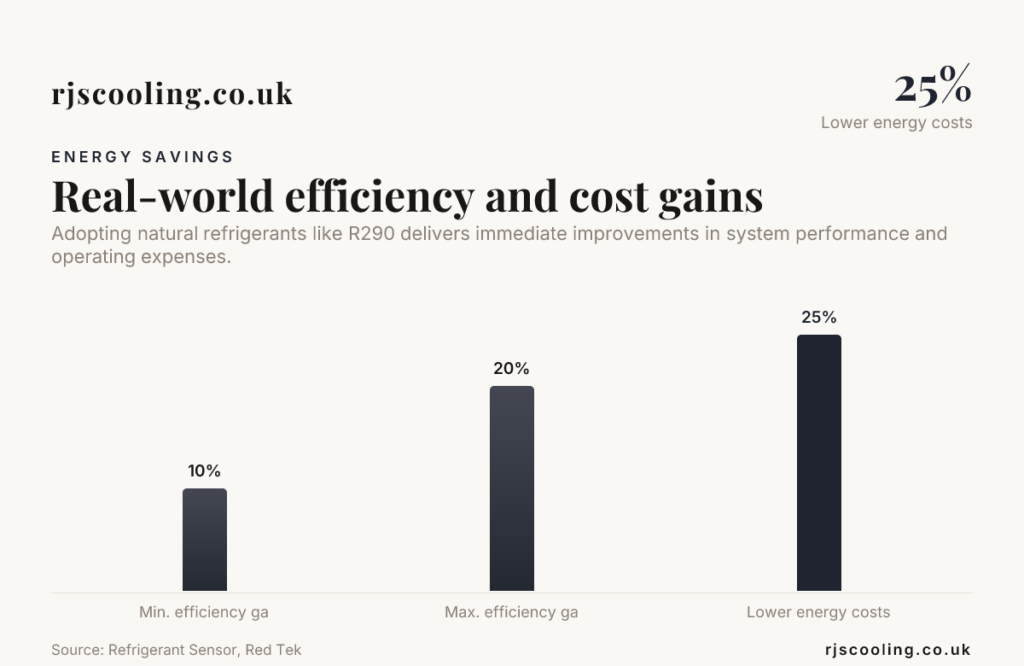
Adopting natural refrigerants like R290 delivers immediate improvements in system performance and operating expenses.
Sizing and System Design: Getting R290 or R32 Right First Time
Correct sizing matters just as much as refrigerant choice, an oversized or undersized system will waste energy whatever gas runs through it.
Our UK AC sizing chart and wider HVAC resources help our customers understand BTU requirements before we even discuss refrigerant type.
Getting this technical information right at the design stage is what stops businesses overspending on running costs later.
Which Refrigerant Should You Choose for Your Business?
There isn’t a single answer that fits every site, which is why R290 vs R32, which natural refrigerant maximises energy savings, always comes back to the specific application in front of us.
Small refrigeration units, bottle coolers and compact air conditioning systems tend to favour R290 for its efficiency and low environmental impact. Larger multi-pack refrigeration installations and bigger heat pump systems often still make more sense with R32, at least until charge limits or system design change.
Our mission is to provide bespoke cooling and heating installations, servicing and maintenance for the commercial and industrial marketplace and to exceed customer expectations, and refrigerant selection is a core part of delivering on that promise.
The Right Fit
When customers ask us R290 vs R32, which natural refrigerant maximises energy savings, the honest answer is that R290 wins on efficiency and environmental impact, while R32 still earns its place in larger systems where charge size restrictions make propane impractical.
We have been established in Hampshire for over 25 years, and helping our customers minimise their energy use by providing advice on regular maintenance schedules and selection of energy efficient products remains at the centre of everything we do. If you’re weighing up R290 vs R32 for your next installation, get in touch with our team and we’ll help you find the right fit.
Frequently Asked Questions
Is R290 better than R32 for energy savings?
In most comparative testing, R290 delivers 10-20% better energy efficiency than older refrigerants and generally edges out R32 on running costs too. However, R32’s higher permitted charge size still makes it the more practical option for larger commercial systems.
Why is R290’s GWP so much lower than R32’s?
R290 (propane) has a GWP of just 3, compared with R32’s GWP of 675, because it’s a naturally occurring hydrocarbon rather than a synthetic HFC gas. This is the main reason R290 is classed as a natural refrigerant while R32 is not.
Is R290 safe to use in commercial air conditioning and refrigeration?
Yes, R290 is safe when installed by qualified engineers who understand its flammability class and charge limits, typically around 150 grams in many applications. Safety comes down to correct design, ventilation and leak detection rather than the refrigerant itself being unmanageable.
Will R32 be phased out in favour of R290?
R32 remains widely used and permitted, particularly in larger systems, so it isn’t being phased out immediately. That said, as more manufacturers push natural refrigerants for their lower GWP, we expect R290 to keep gaining ground in smaller commercial applications.
Which refrigerant should I choose for a small commercial fridge or bottle cooler?
R290 is usually our recommendation for small, self-contained units because the charge size restrictions aren’t an issue and the energy savings are meaningful. For larger multi-pack systems, R32 often remains the more practical choice.
Does refrigerant choice affect heat pump performance as well as cooling?
Yes, refrigerant choice affects both heating and cooling output, since most commercial heat pumps run on the same gas year-round. As a rule of thumb, well-designed heat pumps output 2-3 KW of heat for every KW of electricity input, and the refrigerant plays a direct role in achieving that ratio.
Is switching to R290 worth it for an existing commercial refrigeration system?
It depends on the age and design of the existing system, but for many smaller units the energy savings and lower environmental impact make R290 worth considering at replacement time. Speak to a qualified engineer before assuming any existing system can simply be retrofitted, as compressor and component compatibility need checking first.
Related Posts

How Air Source Heat Pumps Work
How Air Source Heat Pumps Work: A Straightforward Guide for…
Air Source Heat Pumps v Traditional Heating
Air Source Heat Pumps v Traditional Heating: Which One Actually…

Hybrid Heat Pump & Solar PV Integration: Bespoke Solutions for Southampton and Hampshire Businesses
Hybrid Heat Pump & Solar PV Integration: Bespoke Solutions for…