
HEPA vs UV-C Air Purification for Modern Clinical Environments: How to Choose
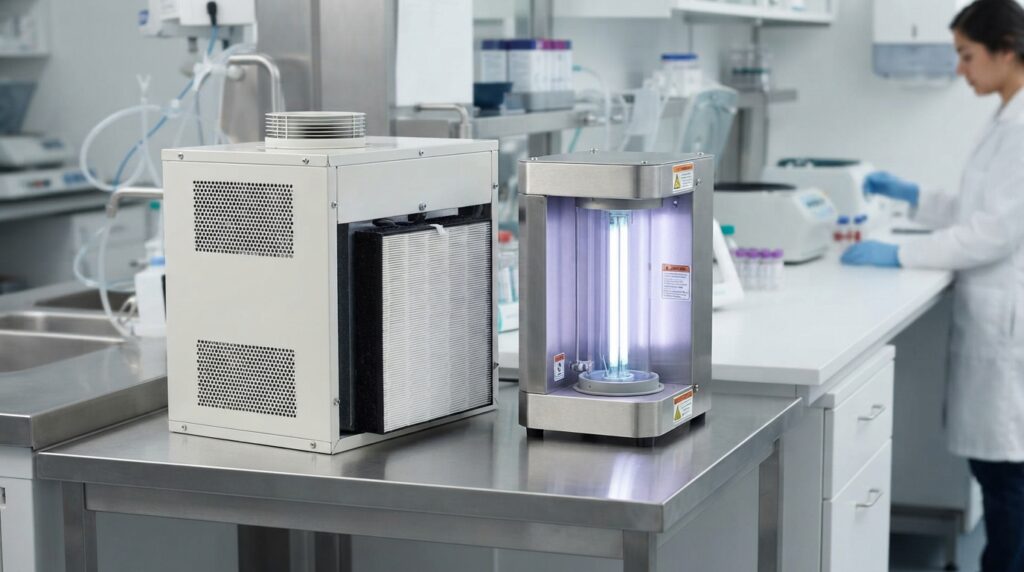
HEPA vs UV-C Air Purification for Modern Clinical Environments comes down to two different jobs: HEPA filtration captures airborne particles, while UV-C can inactivate susceptible microorganisms under suitable treatment conditions. We compare how each works, what to verify in the occupied room, and when a combined approach may suit a clinical space.
Key Takeaways
- HEPA captures particles. Choose it when removing airborne particles and particle-associated contaminants is a priority, and assess the complete device rather than the filter rating alone.
- UV-C inactivates susceptible microorganisms. Its performance depends on UV dose, exposure time and airflow through the treatment zone; UV-C does not remove dust, allergens or gases.
- Room performance matters. Compare clean-air delivery with room volume, check for filter bypass, and consider whether airflow reaches the occupied areas.
- Configuration affects safety and operation. Upper-room UVGI, in-duct treatment and enclosed recirculating units have different installation and exposure-control requirements.
- Use air cleaning alongside ventilation. Air cleaners and UV treatment support, rather than replace, suitable outdoor-air ventilation and clinical infection-control practices.
- Plan for HVAC coordination. The building’s air movement and mechanical design help determine whether an added system will work as intended. Our guidance on ventilation and indoor air quality within HVAC choices provides wider context for that planning.
How HEPA filtration and UV-C work
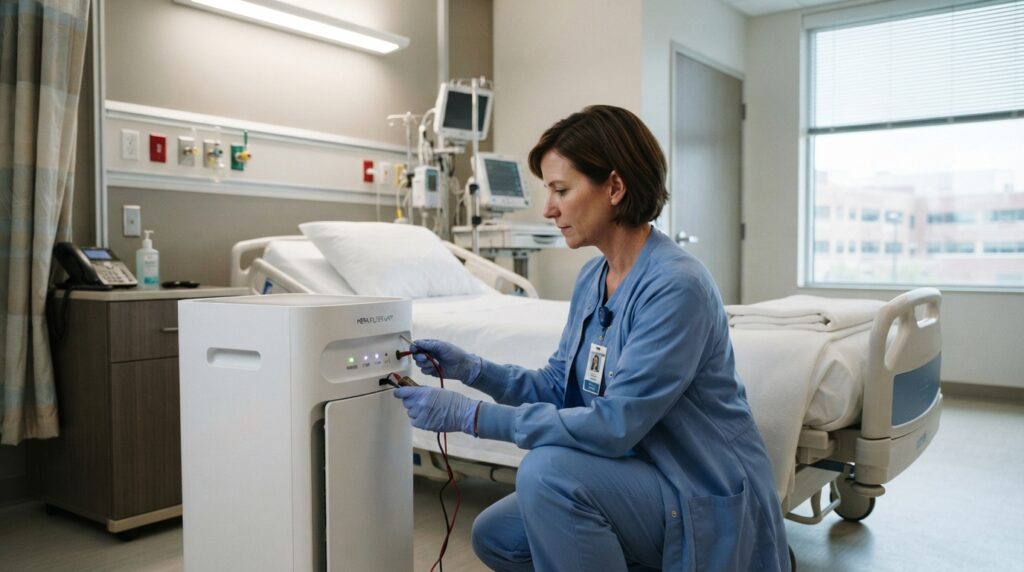
HEPA filters capture particles as air passes through dense filter media. A commonly cited benchmark is 99.97% capture at 0.3 micrometres, and diffusion, interception and impaction help capture particles both smaller and larger than that benchmark size.
Captured material stays in the filter rather than being inactivated, so filter housing, removal and maintenance procedures matter. Droplet nuclei are about 1 to 5μm in diameter, as described by PMC, illustrating why particle filtration can be relevant to airborne contaminants.
UV-C acts differently: it damages microbial genetic material and can inactivate susceptible microorganisms when the delivered dose and exposure conditions are sufficient. It does not remove particles, dust, allergens, smoke or gases from the air.
In short, HEPA filtration is a particle-capture method, while UV-C is a microbial-inactivation method. They are not interchangeable, even when both are used in air-cleaning equipment.
Compare what each approach can and cannot do
| Approach | Main function | What to assess | Key limitation |
|---|---|---|---|
| HEPA filtration | Captures airborne particles and particle-associated contaminants. | Whole-device airflow, room coverage, leakage and filter bypass. | Retains captured material rather than inactivating it, and the filter adds resistance to airflow. |
| UV-C | Inactivates susceptible microorganisms exposed to the treatment. | UV dose, exposure time, airflow through the treatment zone and safe containment. | Does not remove particles or gaseous contaminants. |
Choose HEPA when particle removal is part of the objective, but assess the complete device’s airflow and leakage rather than relying on filter efficiency alone. Two practical drawbacks are that a HEPA filter does not inactivate what it captures and that airflow resistance requires suitable equipment design and planned filter changes.
Consider UV-C when microbial inactivation is a specific goal. The air must receive an adequate UV dose for sufficient exposure time, so airflow rate and the design of the treatment zone affect how much treatment the passing air receives.
UV-C should not be selected to control smoke, odours or gaseous pollutants. A suitably selected activated-carbon stage may help with some gases and odours, but it serves a different purpose from particle filtration and does not replace it.
Laboratory capture or inactivation results describe performance under the tested conditions. On their own, they do not prove reduced transmission or improved clinical outcomes in a particular facility.
Choose the right UV-C system configuration
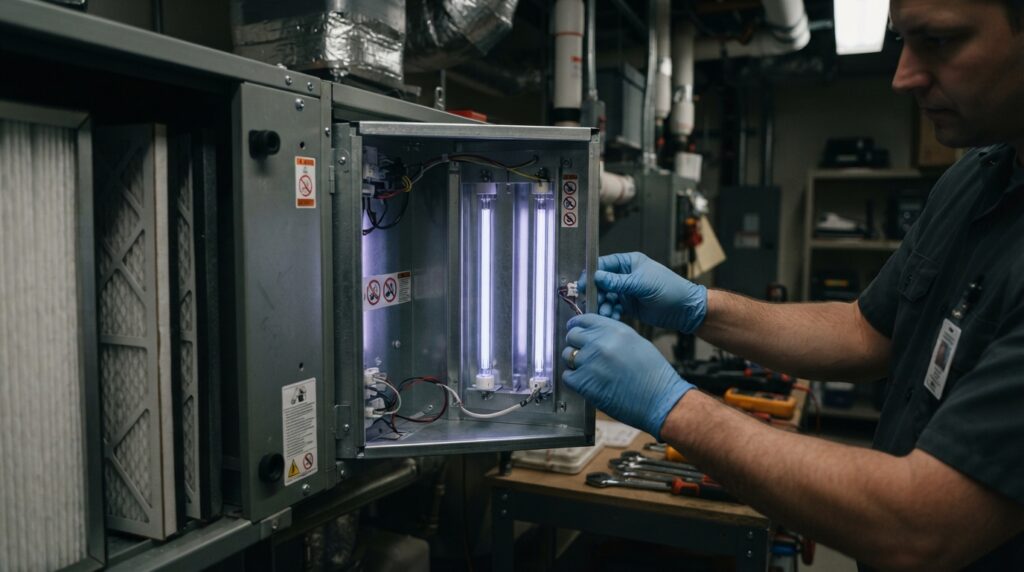
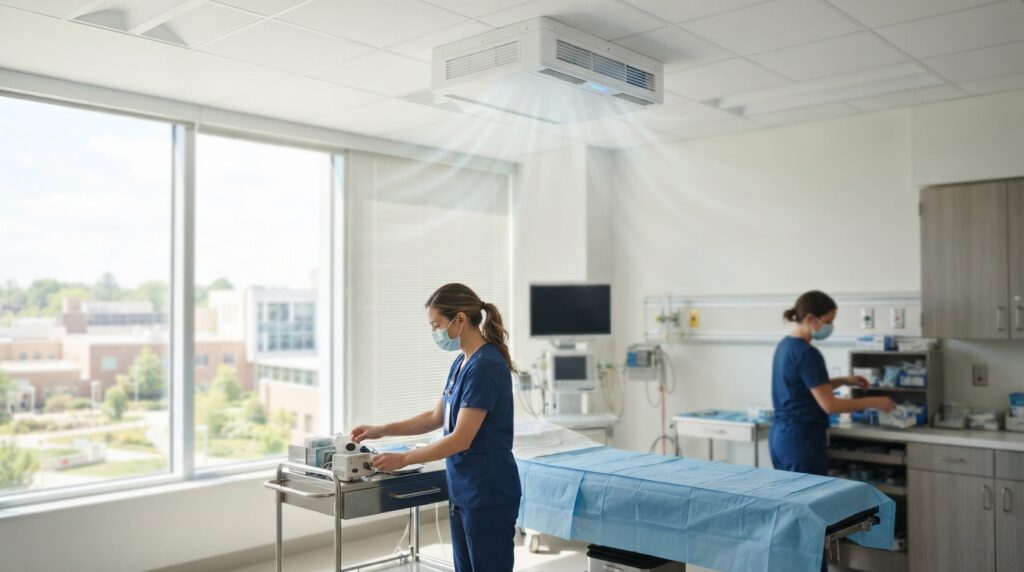
UV-C air purifiers can be safe in occupied spaces when the system is designed to control exposure and installed with appropriate safeguards. The right arrangement depends on room layout, air movement and use, because a UV source specification alone cannot establish how effectively air in the occupied space will be treated.
- Upper-room UVGI treats air that circulates into an irradiated zone above occupants. It depends on effective air mixing and needs controls that limit UV exposure in occupied areas.
- In-duct air treatment exposes air inside HVAC ductwork. Equipment design must suit the duct’s airflow and provide the required exposure time.
- Enclosed recirculating units draw room air through a contained treatment chamber, keeping the UV source shielded from occupants while treating the air that passes through the device.
When fitting an air-cleaning strategy around existing climate-control equipment, air conditioning systems can be supplied and installed for residential, commercial and industrial use, including models from LG, Hitachi, Fujitsu, Daikin, Mitsubishi Electric and Toshiba. Coordinating equipment choices with the room’s layout and air movement helps keep the broader HVAC plan in view.
Make the configuration decision around the room’s actual airflow pattern, not just a lamp description or filter rating. Upper-room, in-duct and enclosed systems treat air in different ways, so their installation and exposure controls need to match their intended use.
Did You Know?
There was a statistically significant 98.83% reduction in airborne pathogens.
Source: PMC
Judge clean-air delivery in the occupied room
A filter rating alone does not show how much clean air reaches a room. Compare the device’s clean-air delivery rate with room volume: equivalent air changes per hour can be estimated by dividing clean-air delivery per hour by room volume, using consistent units.
Check the whole device for airflow bypass, leakage and obstructed intakes or outlets. High media efficiency cannot compensate for air that travels around the filter rather than through it.
Air mixing and placement also affect room coverage. Avoid placing a unit where clean air immediately returns to its intake, or where furniture, partitions or room geometry leave stagnant areas away from the treated airflow.
During commissioning, measure or verify airflow, review coverage and confirm that the installation performs as intended under normal operating conditions. Make-up air coordination is intended to prevent extraction from pulling unwanted draughts, smells or temperature swings from surrounding areas, a useful example of how air movement and pressure balance can affect comfort and room conditions.
Document the arrangement and check that nearby systems do not undermine the intended airflow. The goal is to assess delivered clean air in the occupied room, not simply the advertised performance of one component.
Build in UV-C safety and material checks
UV-C air purifiers can be safe when their design contains or controls exposure, but safety depends on the specific system and installation. Verify shielding, interlocks and access controls where applicable, and include staff exposure checks in commissioning and ongoing review.
Assess the specific wavelength and equipment for potential ozone or other unwanted emissions. Also consider whether prolonged UV exposure could degrade nearby plastics, seals or other materials, based on the installation and operating conditions.
Access to lamps and treatment chambers needs particular attention during maintenance. Commercial air conditioning services for commercial and industrial customers include installation and maintenance, providing a wider HVAC context when facilities plan mechanical work alongside room equipment.
Record the safety measures and confirm that the installed system continues to operate within its intended conditions. Staff should understand the access controls and the safe procedure for work around the equipment.
Decide when to combine HEPA and UV-C
Combine HEPA capture and UV-C when both particle removal and microbial inactivation are relevant goals. Verify the airflow path and treatment conditions for each stage, because air must pass through the filter and receive adequate UV treatment for the respective functions to be delivered.
Ventilation and air cleaning work as complementary measures. Neither an air cleaner nor UV treatment replaces suitable outdoor-air ventilation, isolation procedures or other infection-control practices.
Coordinate equipment selection with HVAC design and clinical use so added air cleaning does not disrupt ventilation balance, comfort or intended airflow patterns. Our commercial HVAC design guidance covers broader design considerations for building systems.
Planned air conditioning servicing and maintenance for commercial and industrial systems can sit alongside performance reviews, particularly when building equipment or room use changes. Keep that work coordinated with the air-cleaning system so its intended airflow and operating conditions remain clear.
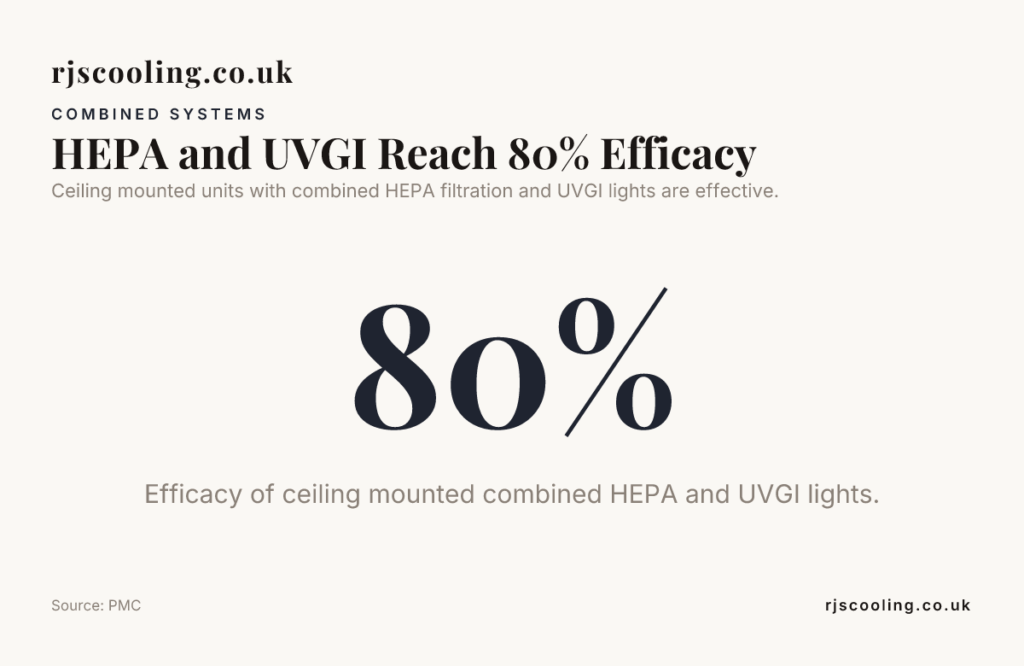
Ceiling mounted units with combined HEPA filtration and UVGI lights are effective.
Did You Know?
69%–80% of all pathogens that cause infections are airborne.
Source: PMC
Plan maintenance and performance review
Track filter condition and pressure drop, then replace filters according to the equipment’s specified maintenance requirements. Use appropriate handling practices for used filters because captured material remains in the filter media.
Inspect UV lamps, sleeves, airflow paths and safety controls on a planned schedule. Fouling, ageing or failed components can reduce the treatment delivered, while damaged shielding or controls can create an exposure risk.
Keep commissioning results and repeat airflow, containment and operational checks after maintenance, room changes or equipment adjustments. These records make it easier to identify when a change in room use or equipment condition affects performance.
Review equipment performance alongside ventilation and infection-control practices. Device indicators and laboratory findings alone do not establish clinical outcomes, so use them as part of a wider operational review.
Frequently Asked Questions
What type of air purifier do hospitals use?
Hospitals use different air-cleaning approaches according to room function and building design, including central HVAC filtration, portable HEPA units and UVGI in selected applications. The choice is based on the air-cleaning task and how the equipment fits clinical operations.
Can a HEPA filter capture viruses?
Yes—virus-containing aerosols can be captured as they pass through the filter.
Does UV-C air purification produce ozone?
Some can; check the lamp’s wavelength and emission characteristics.
Can an air purifier replace an isolation room?
No. An air purifier cannot provide the room pressure relationships, controlled exhaust and clinical procedures used to manage isolation, so it cannot serve as a substitute for an isolation room.
Can a portable HEPA unit be used during patient procedures?
Yes, as a supplementary measure; position it so its discharge does not disturb airflow around the patient or work area.
Should a HEPA air purifier run continuously?
Continuous operation can provide a steadier supply of filtered air than intermittent use, provided the device is operated within its intended conditions. Facilities can align run schedules with room occupancy and clinical workflows.
Purpose
HEPA vs UV-C Air Purification for Modern Clinical Environments is a choice between particle capture and microbial inactivation, with different strengths, limitations and safety requirements. Select equipment according to the room’s purpose, verify clean-air delivery and airflow in the occupied space, and coordinate the system with ventilation and infection-control practice.
When both particle removal and microbial inactivation matter, a combined approach may suit the facility if each treatment stage is properly designed and verified. A practical commissioning and maintenance plan helps keep performance, staff safety and room conditions under review.
Created with AI assistance and reviewed by a human